
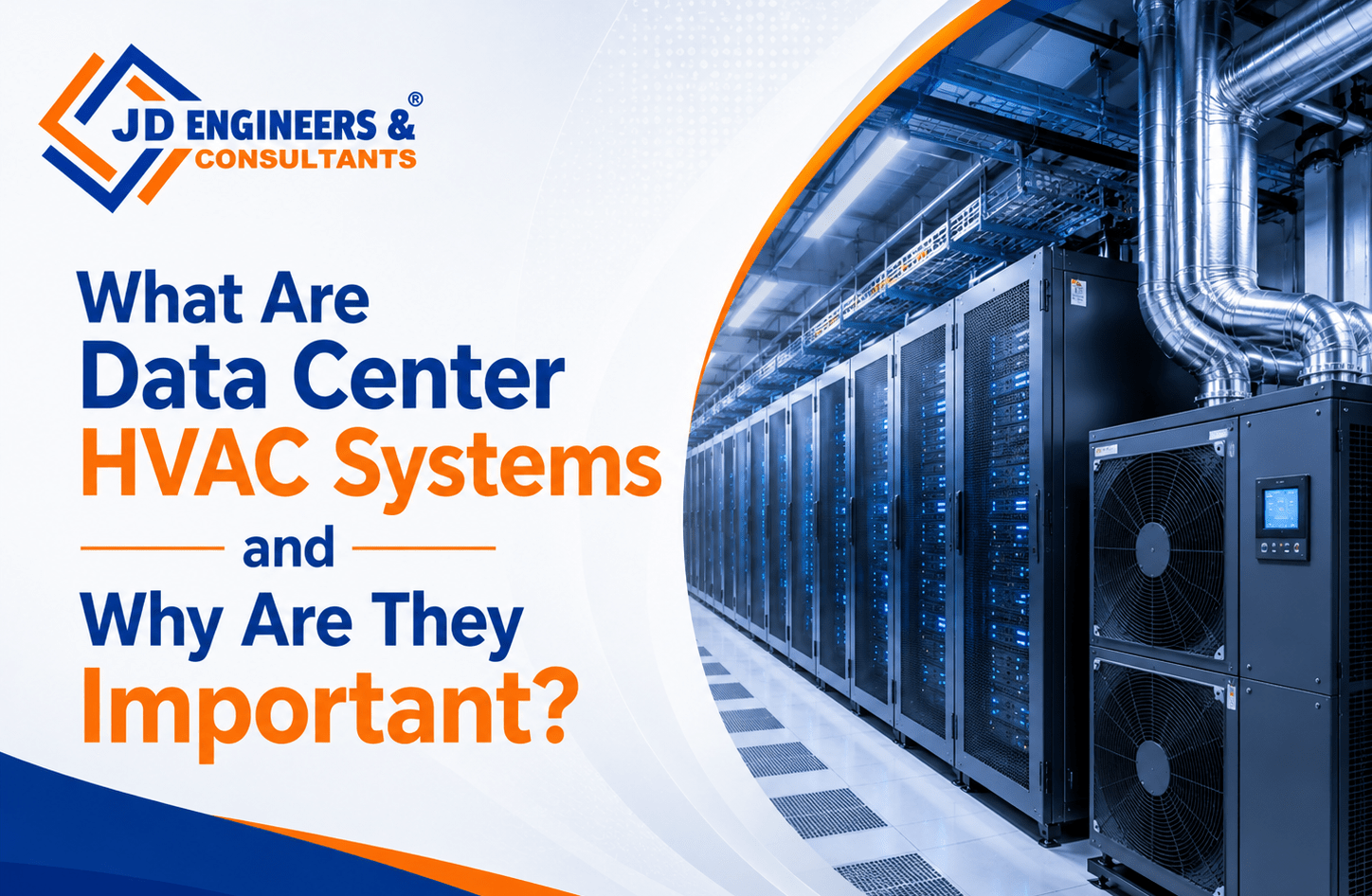
If your business depends on servers, networks, or cloud infrastructure, then understanding data center HVAC systems is not optional. It is essential.
Data center HVAC systems are the heating, ventilation, and air conditioning solutions designed specifically to control temperature, humidity, and airflow inside a data center. Without a reliable Engineering design and Consulting Services servers overheat, equipment fails, and business operations come to a halt. This guide breaks down what these systems are, how they work, and why they are a critical investment for any facility running IT infrastructure.
What Is an HVAC System for a Data Center?
A standard office HVAC system keeps people comfortable. An HVAC system for a data center does something far more demanding. It maintains precise environmental conditions around the clock to protect sensitive electronic equipment.
Servers and networking hardware generate enormous amounts of heat during normal operation. A typical server rack can produce between 5 and 20 kilowatts of heat. Without a purpose-built data center air conditioning system, this heat accumulates rapidly, pushing temperatures beyond safe operating limits and shortening equipment life.
Key functions of a data center HVAC system include:
- Removing heat generated by IT equipment continuously
- Maintaining temperature within the recommended range of 18°C to 27°C (ASHRAE A1 guidelines)
- Controlling relative humidity between 40% and 60% to prevent static discharge and condensation
- Ensuring consistent airflow to eliminate hot spots
- Supporting energy efficiency to reduce operational costs
A properly designed HVAC system for a data center handles all of these demands simultaneously, 24 hours a day, seven days a week, without interruption.
Types of Data Center Cooling Systems
Not all data center cooling solutions are the same. The right system depends on the size of the facility, the density of the equipment, and the available budget. Here are the most widely used approaches:
1. Computer Room Air Conditioning (CRAC) Units
CRAC units are among the most traditional forms of server room cooling systems. They circulate chilled air throughout the computer room using refrigerant-based cooling. They are reliable and well-suited to small and mid-sized facilities.
2. Computer Room Air Handlers (CRAH)
CRAH units use chilled water supplied from an external chiller plant rather than refrigerant. They offer greater scalability and energy efficiency, making them a popular choice for large-scale data center infrastructure cooling.
3. Precision Cooling Systems
Precision cooling in data centers targets the specific areas where heat is generated rather than cooling the entire room. In-row cooling units and overhead cooling systems deliver conditioned air directly to the source of heat. This approach reduces energy waste and improves overall thermal management.
4. Liquid Cooling Solutions
For high-density computing environments, liquid cooling is increasingly preferred. Direct liquid cooling (DLC) and immersion cooling bring coolant into contact with processors and components, handling heat loads that air-based systems cannot manage effectively.
5. Free Cooling and Economizer Systems
These systems use outdoor air or ambient conditions to supplement or replace mechanical cooling when external temperatures are low enough. Free cooling is a significant component of energy-efficient HVAC design for data centers in suitable climates.
Why Is Data Center Temperature Control So Critical?
Data center temperature control is not just about keeping equipment comfortable. It directly affects business continuity, hardware lifespan, and operating costs.
Research from the Uptime Institute shows that thermal-related failures are among the leading causes of unplanned data center outages. Every degree above the recommended threshold accelerates component degradation. A server operating at 35°C will fail significantly sooner than one kept at 22°C.
Beyond hardware longevity, poor data center thermal management carries serious financial consequences. Unplanned downtime costs enterprises an average of USD 9,000 per minute, according to Gartner. Investing in a dependable data center cooling system is, in practice, an investment in operational resilience.
Critical reasons temperature control matters:
- Prevents thermal throttling, which reduces server performance under heat stress
- Protects hard drives, capacitors, and power supplies from premature failure
- Maintains safe humidity levels that prevent corrosion and electrostatic discharge
- Supports compliance with data center facility standards such as ASHRAE, TIA-942, and ISO/IEC 24764
- Reduces insurance risk for facilities managing sensitive data
How HVAC Design for Data Centers Differs from Standard HVAC
Standard residential or commercial HVAC design focuses on occupant comfort. HVAC design for data centers is an entirely different engineering discipline.
Data centers demand continuous operation with zero tolerance for downtime. This means every component of the data center air conditioning system must be designed with redundancy. Common design principles include N+1 or 2N redundancy configurations, ensuring that a single component failure does not compromise the entire cooling infrastructure.
Airflow management is another key differentiator. Engineers design hot aisle and cold aisle containment strategies to direct cold air precisely to equipment intakes while capturing exhaust heat efficiently. This structured airflow approach is fundamental to modern data center infrastructure cooling and directly impacts power usage effectiveness (PUE).
An experienced engineering solutions provider applies computational fluid dynamics (CFD) modelling during the design phase. CFD simulations identify potential hot spots before construction begins, allowing engineers to optimize rack layouts, duct placement, and cooling unit positioning for maximum effectiveness.
Data Center HVAC and Energy Efficiency
Energy consumption is one of the largest operating costs for any data center. Data center cooling solutions account for roughly 30 to 40 percent of total facility energy use. Poorly designed or aging systems push that figure even higher.
Modern precision cooling in data centers dramatically reduces energy waste. Variable speed drives on fans and compressors, intelligent building management systems, and economizer integration all contribute to lower power usage effectiveness (PUE) scores.
A PUE of 1.0 represents perfect efficiency where all power goes to IT equipment. Well-designed facilities with optimized data center thermal management regularly achieve PUE scores between 1.2 and 1.4, compared to industry averages that once exceeded 2.0.
For businesses looking to reduce carbon footprints and meet sustainability targets, choosing the right HVAC system for data centers is one of the highest-impact decisions available.
Why Work with an Engineering Solutions Provider for Data Center HVAC?
Designing and implementing a data center HVAC system requires deep technical expertise. Errors in system sizing, airflow modeling, or redundancy planning can lead to equipment failure, costly retrofits, or catastrophic data loss.
Working with a qualified engineering solutions provider like JD Engineers and Consultants means your HVAC design for data centers is grounded in engineering best practices, real-world experience, and compliance with current standards. Whether you are building a new facility, expanding existing capacity, or upgrading aging infrastructure, professional engineering guidance reduces risk and maximizes long-term performance.
If you are searching for engineering firms near me with proven expertise in data center cooling solutions, JD Engineers and Consultants delivers technical solutions that protect your infrastructure investment.
FAQs About Data Center HVAC Systems
Q1. Why is HVAC important in data centers?
HVAC keeps servers cool, prevents overheating, and avoids downtime or data loss.
Q2. Do data centers require HVAC tech?
Yes, they need specialized 24/7 precision cooling systems, not normal AC.
Q3. Ideal temperature range?
18°C to 27°C (best: 20°C–24°C for safe operation).
Q4. What is precision cooling?
Targeted cooling for servers only, reducing hot spots and saving energy.
Q5. How does HVAC affect energy efficiency?
Good HVAC design can cut energy use by 30–50% and improve PUE.
Ready to Optimize Your Data Center Cooling Infrastructure?
At JD Engineers and Consultants, we specialize in data center HVAC systems, precision cooling design, and full-facility thermal management for businesses across industries. Whether you need a complete HVAC design for your data center or want to upgrade your existing server room cooling system, our team of certified engineers is ready to help.
Contact JD Engineers and Consultants today for a consultation and discover how the right data center cooling solution can protect your infrastructure, reduce energy costs, and future-proof your facility.
Call us, email us, or fill out the contact form on our website. We are the engineering solutions provider built to deliver results.