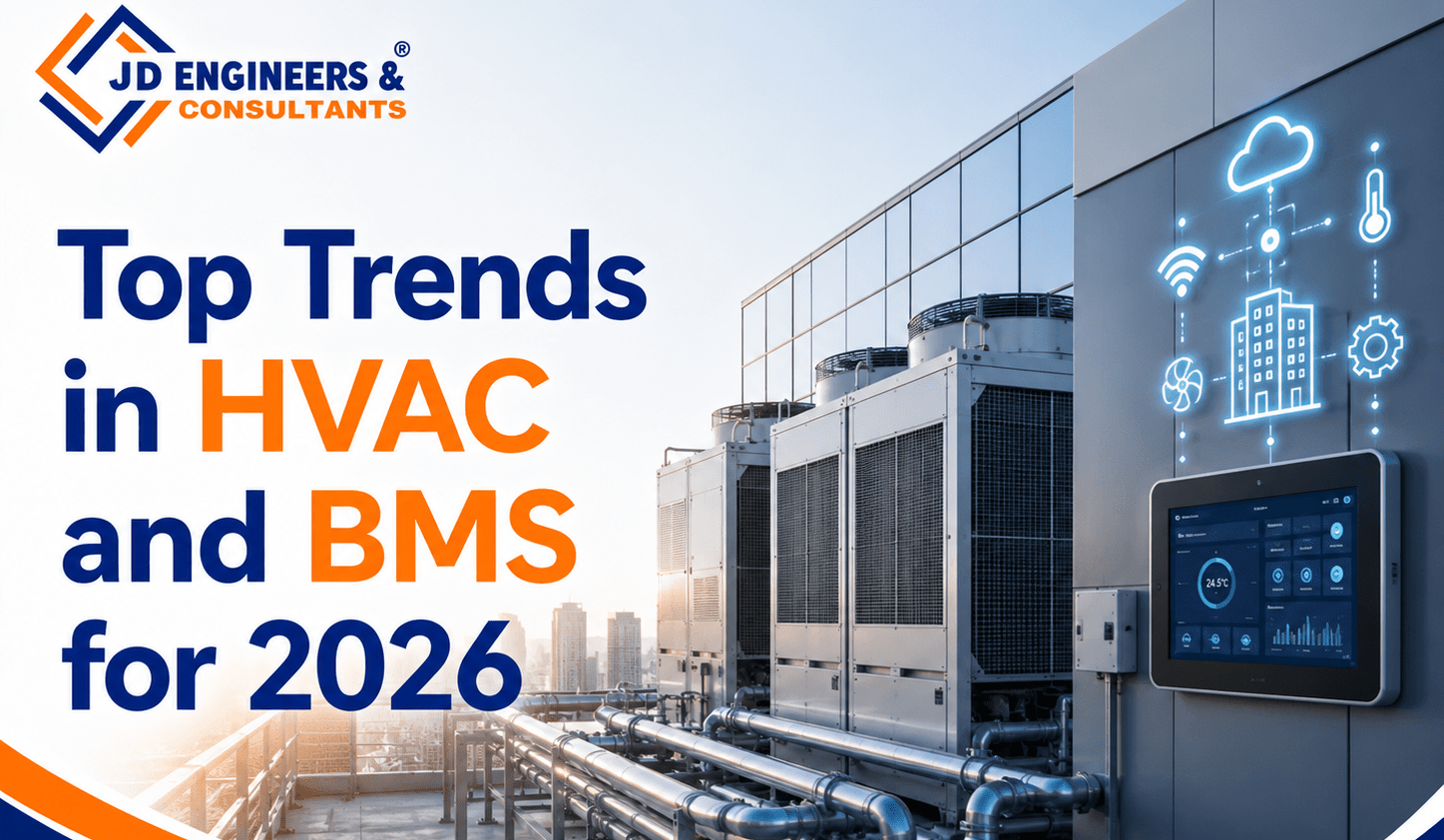

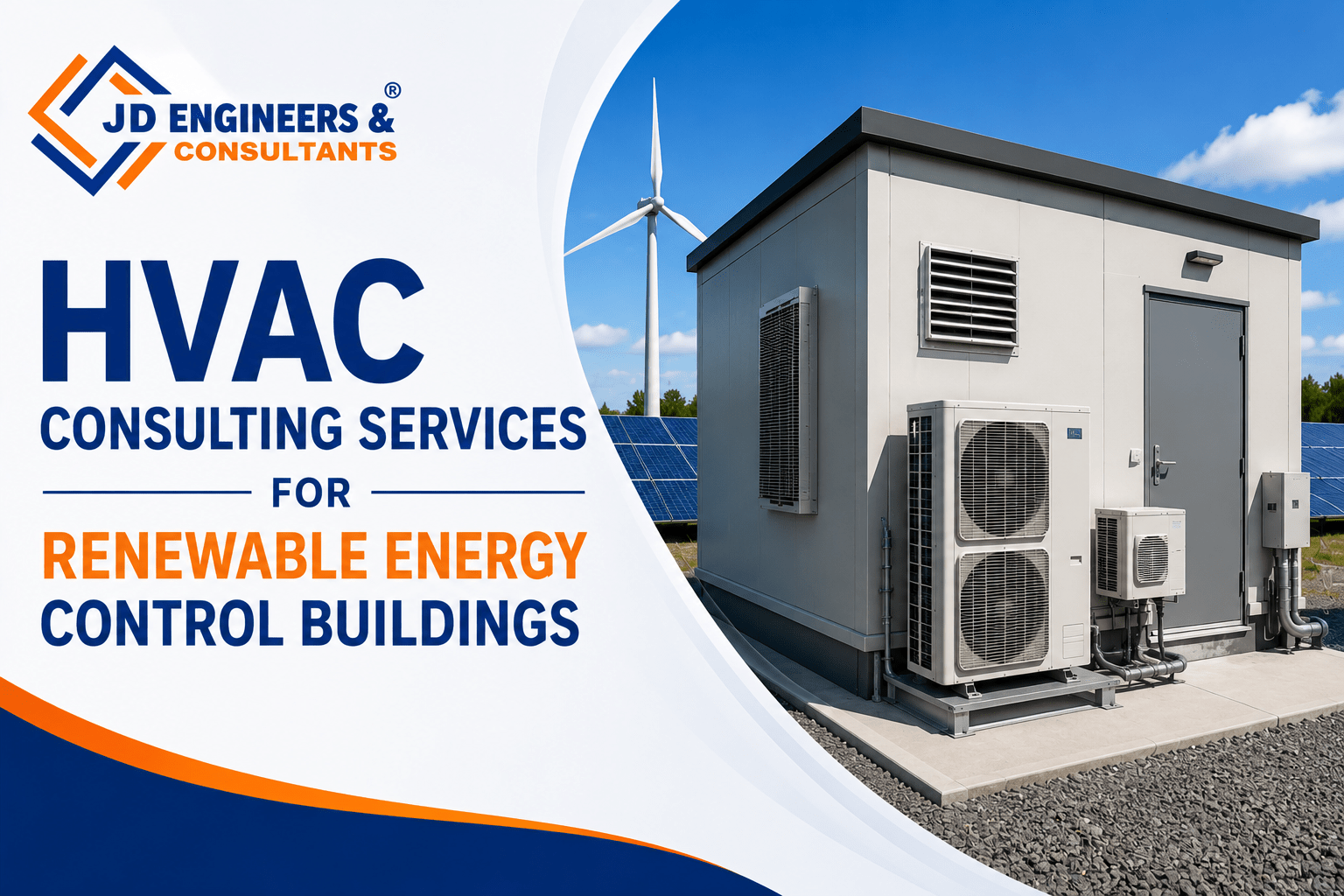
Renewable energy projects rely on control buildings that house sensitive electrical and electronic systems. These structures need stable temperature, humidity, and air quality control to keep equipment running safely. HVAC Consulting Services for Renewable Energy Control Buildings help solar farms, wind sites, and battery storage facilities protect critical equipment while meeting strict safety codes. Reliable HVAC for Renewable Energy Facilities and thoughtful Renewable Energy Control Building HVAC Design go hand in hand with safe, efficient site performance. JD Engineers & Consultants brings hands-on engineering experience to every stage of the project, from load calculations to final commissioning.
Why Renewable Energy Control Buildings Need Specialized HVAC Engineering Services
Control buildings on renewable energy sites are not ordinary structures. They house SCADA panels, switchgear, inverters, and battery racks that generate constant heat. Standard commercial HVAC engineering services are not built to handle this kind of continuous, high density heat load.
Equipment inside these buildings often runs around the clock. A short cooling failure can trigger equipment shutdowns, costly downtime, or permanent damage to expensive electronics. This is why renewable energy developers turn to a specialized HVAC consultant rather than a general contractor.
Many of these sites also sit in remote or harsh locations, such as deserts, coastal wind corridors, or open plains. Dust, humidity, salt air, and temperature swings all place extra demand on mechanical systems. A well planned HVAC design accounts for these site conditions from day one.
- Continuous cooling for equipment that operates around the clock
- Protection against dust, humidity, and corrosive air at remote sites
- Compliance with manufacturer thermal limits for inverters and battery racks
- Redundant systems that prevent unplanned shutdowns
Core Components of HVAC Consulting and Engineering Services for Renewable Projects
A complete package of Consulting and Engineering Services covers far more than selecting a cooling unit. It starts with a detailed heat load calculation based on the actual equipment inside the building. From there, the consultant selects systems sized to match real operating conditions, not generic assumptions.
Good HVAC System Engineering Solutions also include filtration design, pressurization strategy, and controls integration with the site’s broader monitoring platform. Every decision is checked against relevant codes and the manufacturer’s environmental specifications for the electrical gear inside.
- Heat load calculations based on actual equipment heat dissipation data
- Equipment selection, including packaged units, split systems, and ductless options
- Filtration and positive pressurization to limit dust and contaminants
- Redundant or N+1 system design for mission critical reliability
- Energy modeling to support long term operating cost goals
- Commissioning and performance testing before handover
HVAC Design for Solar Power Plants: Key Considerations
Solar farms often sit in hot, dusty, and sun exposed locations. HVAC Design for Solar Power Plants must account for high ambient temperatures outside the building as well as the heat generated by inverters and transformers inside it.
Inverter rooms typically need packaged cooling units sized to the manufacturer’s thermal data sheet, sealed enclosures to keep dust out, and backup cooling capacity. Without it, inverters can overheat and automatically reduce output during peak sun hours, which cuts energy production and revenue.
Filtration matters just as much as cooling capacity in desert and arid environments. A clogged filter or an unsealed duct can let in enough dust to damage sensitive control boards within months.
HVAC Systems for Wind Farm Control Buildings
Wind farm control buildings face a different set of challenges. HVAC Systems for Wind Farm Control Buildings often need to handle remote access limitations, harsh weather, and in offshore or coastal projects, salt laden air that accelerates corrosion.
Coils, cabinets, and fasteners are usually specified with corrosion resistant coatings or materials. Because technicians may not visit daily, control systems should include remote monitoring and alarm notifications to catch problems early.
Vibration from nearby turbines and substations is another factor that consultants account for when selecting mounting hardware and ductwork supports.
HVAC for Battery Energy Storage Systems (BESS): Thermal Management Essentials
Battery storage is one of the fastest growing parts of the renewable energy industry, and it comes with some of the strictest cooling requirements. HVAC for Battery Energy Storage Systems (BESS) must keep battery racks within a tight temperature band, often between roughly 59°F and 77°F, to protect performance and battery life.
Poor thermal management in a BESS building is not just an efficiency issue. Overheated batteries carry a risk of thermal runaway, which is why fire protection standards such as NFPA 855 set requirements for ventilation, smoke detection, and explosion control. A qualified HVAC consultant coordinates HVAC design with fire protection engineering to meet these requirements.
Redundant cooling, off-gas ventilation, and continuous monitoring are now standard expectations for any serious BESS project.
Energy-Efficient HVAC Solutions for Long-Term Savings
It would work against the purpose of a renewable energy site to run inefficient mechanical equipment. Energy-Efficient HVAC Solutions help control buildings reduce their own power draw, which supports the sustainability goals of the larger project.
Variable speed compressors, smart thermostats, and remote monitoring platforms all help cut energy waste without compromising equipment protection. Where the climate allows, economizer cycles can use outside air for free cooling during cooler months.
Standards published by ASHRAE give engineers a benchmark for efficient mechanical design in industrial and commercial buildings. Following these guidelines helps keep operating costs predictable over the life of the facility.
How to Choose the Right HVAC Consultant for Industrial Renewable Energy Projects
Not every mechanical engineering firm has direct experience with renewable energy infrastructure, which is why Industrial HVAC Consulting for Renewable Energy projects calls for the right partner. When selecting a firm for a solar, wind, or storage project, a few questions help separate qualified firms from general contractors.
Has the firm designed systems for inverter rooms, battery enclosures, or wind farm substations before? Are their engineers licensed professionals who understand NEC, NFPA, and local building codes? Can they support the project from early feasibility through construction administration and commissioning, rather than handing off a design and moving on?
A consultant who understands both renewable energy operations and mechanical engineering brings a level of insight that generic HVAC vendors often miss.
- Proven experience with solar, wind, or battery storage projects
- Licensed professional engineers on staff
- Familiarity with NFPA, NEC, and local jurisdiction codes
- Support through design, construction, and commissioning phases
The JD Engineers & Consultants Approach to HVAC System Engineering Solutions
JD Engineers & Consultants works with renewable energy developers, EPC contractors, and asset owners to deliver complete HVAC System Engineering Solutions for control buildings of every type. Our team has hands-on experience with solar inverter rooms, wind farm substations, and battery storage enclosures across a range of climates and site conditions.
Every project starts with a clear understanding of the equipment to be installed and the environmental conditions on site. From there, our engineers prepare load calculations, system designs, and specifications that meet relevant codes, manufacturer requirements, and guidance from organizations such as the U.S. Department of Energy. We support clients through construction administration and commissioning to confirm the system performs as designed.
Because we work across multiple disciplines, our HVAC Engineering Services are coordinated with electrical, fire protection, and structural design from the start, rather than added as an afterthought late in the project.
FAQs About HVAC Consulting Services for Renewable Energy Control Buildings
1. What is HVAC consulting for renewable energy control buildings?
It is specialized mechanical engineering support for the buildings that house electrical and control equipment at solar, wind, and battery storage sites. A consultant calculates heat loads, designs cooling and ventilation systems, and confirms the design meets relevant codes and equipment manufacturer requirements.
2. Why do solar and wind control buildings need different HVAC design than office buildings?
These buildings house equipment that runs continuously and generates significant heat, unlike a typical office space. They also tend to sit in remote or harsh locations, so the HVAC system must handle higher heat loads, dust, humidity, or salt air with limited routine maintenance access.
3. What temperature range should a battery energy storage system (BESS) maintain?
Most battery chemistries perform best when kept within roughly 59°F to 77°F (15°C to 25°C), though exact ranges depend on the battery manufacturer’s specifications. Staying outside this range can reduce battery life and, in worst cases, raise the risk of thermal runaway.
4. How is industrial HVAC consulting different from standard commercial HVAC design?
Industrial HVAC consulting for renewable energy projects focuses on protecting sensitive electrical equipment rather than human comfort alone. It involves tighter tolerances, redundancy planning, and close coordination with electrical and fire protection engineering.
5. How do I choose the right HVAC consultant for a renewable energy project?
Look for a firm with direct experience designing for solar, wind, or battery storage facilities, licensed engineers on staff, and the ability to support the project from design through commissioning. Asking for references from similar projects is a reasonable way to confirm experience.
Get Started With Expert HVAC Consulting Services for Renewable Energy Control Buildings
A control building is only as reliable as the mechanical system protecting the equipment inside it. JD Engineers & Consultants offers complete HVAC Consulting Services for Renewable Energy Control Buildings, from early stage load calculations to final commissioning, for solar, wind, and battery storage projects of any size.
Reach out to JD Engineers & Consultants today to discuss your project and request a consultation. Our engineering team is ready to help you protect your equipment, control operating costs, and keep your renewable energy facility running the way it was designed to.