
India is one of the largest suppliers of generic medicines in the world. This scale brings sharp focus on quality, and that quality begins with the manufacturing environment itself.
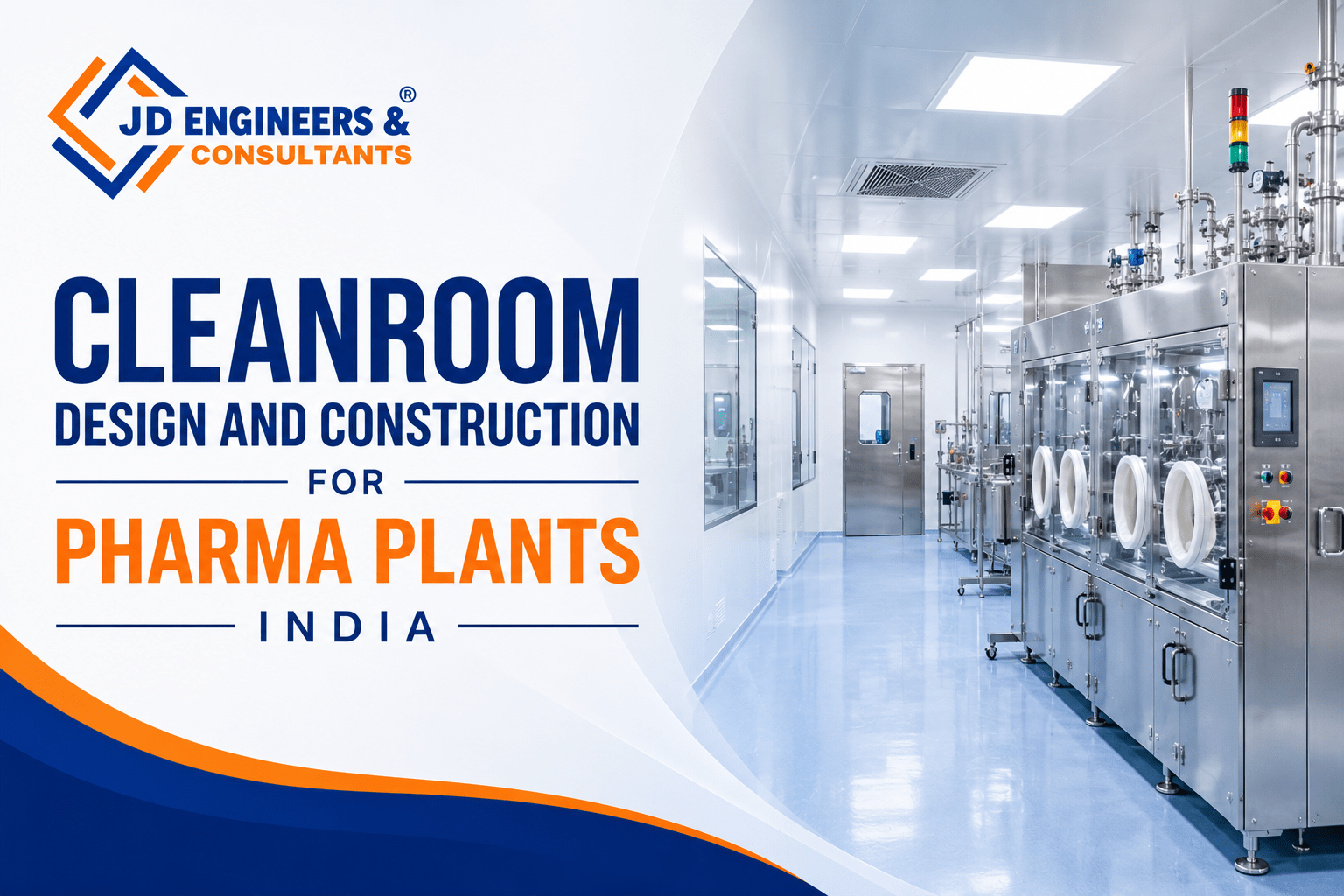
Cleanroom design and construction for pharma plants India is no longer treated as a one-time project. It is an ongoing commitment to contamination control, regulatory compliance, and patient safety. JD Engineers & Consultants, a trusted Engineering Consulting Company in India, has put together this guide to help pharma manufacturers, plant heads, and quality teams understand what a compliant cleanroom actually requires.
Whether you are setting up a new sterile manufacturing line or upgrading an existing facility to meet the Revised Schedule M norms, this guide covers the design principles, construction steps, validation requirements, and the right way to choose a partner for the job.
Why Cleanroom Design and Construction for Pharma Plants India Matters
A cleanroom is not just a clean looking room. It is a controlled environment engineered to limit airborne particles, microbes, and pressure fluctuations that could compromise a drug product.
For Indian pharmaceutical manufacturers, this matters more than ever. The Central Drugs Standard Control Organisation (CDSCO) has rolled out the Revised Schedule M, which brings India’s Good Manufacturing Practice (GMP) requirements much closer to international benchmarks set by the World Health Organization and other global regulators.
Poor cleanroom design for pharmaceutical manufacturing can lead to product recalls, failed audits, and in serious cases, patient harm. Recent enforcement actions against contaminated formulations have made it clear that infrastructure quality is being scrutinised more strictly than before. Investing in proper cleanroom design and construction for pharma plants India protects your manufacturing licence, your export potential, and your brand’s reputation.
Understanding Cleanroom Classifications: ISO and GMP Standards Explained
Every pharmaceutical cleanroom is classified by how clean its air actually is. The global benchmark for this is ISO 14644-1, which defines air cleanliness across nine classes based on the number of particles allowed per cubic metre of air.
In pharmaceutical manufacturing, ISO Class 5 to ISO Class 8 cleanrooms are most common. GMP cleanroom design consultants typically map these ISO classes to EU GMP Grades A, B, C, and D. Grade A areas, used for aseptic filling, demand the strictest control, while Grade D areas, used for less critical processes, allow somewhat relaxed limits.
The World Health Organization’s GMP guidelines for sterile pharmaceutical products reinforce this classification system and add specific requirements around environmental monitoring, gowning procedures, and contamination control strategy. This is especially relevant for sterile manufacturing facility design India projects, where even small airflow miscalculations can compromise an entire production batch.
Choosing the right ISO cleanroom design services for your product type, whether it is an injectable, an ophthalmic, or a biologic, is the first decision that shapes your entire facility layout. Getting this step wrong early is far more expensive to fix once construction begins.
Key Elements of Pharmaceutical Cleanroom Design
Good pharmaceutical plant cleanroom design balances regulatory compliance with practical, day-to-day workflow. A few elements decide whether a cleanroom performs well once it is operational.
- Cleanroom HVAC design for pharma plants: Air handling units, HEPA filtration, air change rates, and pressure cascades between rooms form the backbone of contamination control.
- Material selection: Walls, floors, and ceilings need non-shedding, cleanable, chemical-resistant finishes such as epoxy flooring and coved panel joints.
- Airlocks and gowning rooms: These manage the movement of people and materials between different cleanliness grades without breaking pressure differentials.
- Lighting and utility points: Fixtures, sockets, and service panels need flush, sealed designs that do not trap dust or moisture.
- Layout and flow: Personnel, material, and waste movement should follow a unidirectional path to prevent cross-contamination.
A dependable Pharma cleanroom engineering services provider will model airflow and pressure cascades on paper before a single panel goes up.
Cleanroom Construction Process for Pharma Plants in India
Once the design is finalised, execution becomes the priority. Experienced Pharma cleanroom construction contractors in India generally follow a structured sequence:
- Site assessment and utility mapping, covering power, water, and compressed air needs.
- Civil work for floors, walls, and structural support suited to modular cleanroom panel systems.
- Installation of HVAC ductwork, HEPA filters, and air handling units.
- Fit-out of wall and ceiling panels, doors, viewing windows, and pass boxes.
- Electrical, instrumentation, and building management system integration.
- Commissioning and pre-validation checks before formal handover.
Many manufacturers now prefer Cleanroom turnkey solutions India because they place design, procurement, construction, and validation under one accountable team. This reduces handoff delays between contractors and keeps the project aligned with a single compliance roadmap from day one.
How to Choose the Right Pharmaceutical Cleanroom Design Consultants in India
Not every contractor understands pharmaceutical compliance. The right Pharmaceutical cleanroom design consultants India bring more than construction skills; they bring regulatory fluency to the table.
When evaluating a Cleanroom construction company India, look for the following:
- Experience working with CDSCO, WHO-GMP, and Revised Schedule M requirements.
- In-house engineering teams covering HVAC, electrical, and validation, not just civil contractors.
- A track record across dosage forms such as injectables, ophthalmics, and oral solids.
- Clear documentation practices for design qualification and as-built drawings.
- Willingness to support you through audits, not just hand over the keys and leave.
JD Engineers & Consultants works as one of the Cleanroom engineering consultants India pharma companies rely on for end-to-end project delivery, from concept layout to final qualification.
Cleanroom Validation Services in India: The Final, Non-Negotiable Step
A cleanroom is not compliant until it is validated. Cleanroom validation services India providers typically run the facility through Installation Qualification, Operational Qualification, and Performance Qualification, commonly shortened to IQ, OQ, and PQ.
This includes particle count testing, airflow visualisation studies, recovery time tests, and microbial monitoring under both at-rest and in-operation conditions. The documentation generated at this stage becomes the evidence regulators will ask for during inspection.
Skipping or rushing validation is one of the most common reasons Indian pharma units fail CDSCO inspections under the Revised Schedule M framework. A facility that looks compliant on paper but lacks validated performance data still carries real regulatory risk.
Common Challenges in Cleanroom Design and Construction for Pharma Plants India
Most projects run into a similar set of obstacles.
- Underestimating HVAC load calculations, which leads to pressure cascade failures later.
- Choosing low-cost materials that fail cleanability or fire safety requirements.
- Treating validation planning as an afterthought instead of part of the original design brief.
- Poor coordination between civil, mechanical, and electrical teams, causing avoidable rework.
- Lack of clarity around Revised Schedule M timelines, particularly for MSME manufacturers.
Bringing in experienced Pharmaceutical facility engineering consultants early in the project helps avoid most of these issues before they turn into costly change orders.
Why Choose JD Engineers & Consultants for Your Cleanroom Project
JD Engineers & Consultants operates as the kind of Industrial Engineering Consultants India pharma companies turn to when compliance cannot be an afterthought. As a full-service Engineering Consultancy Services India provider, the team handles cleanroom design, HVAC engineering, construction management, and validation support under one roof.
For pharma companies planning a greenfield facility or a brownfield upgrade, working with a single Pharma plant cleanroom setup consultant keeps the project accountable, on schedule, and aligned with current CDSCO expectations from the very first drawing to the final qualification report.
FAQs About Cleanroom Design and Construction for Pharma Plants India
1. What ISO class is required for pharmaceutical manufacturing cleanrooms in India?
Most sterile manufacturing areas in India operate between ISO Class 5 and ISO Class 8, depending on the process involved. Aseptic filling areas typically require ISO Class 5, equivalent to EU GMP Grade A, while supporting areas may use ISO Class 7 or 8.
2. How long does cleanroom design and construction take for a pharma plant in India?
A standard project, from design finalisation through to validation, usually takes four to nine months. Timelines depend on facility size, HVAC complexity, and how efficiently civil and mechanical work can be sequenced together.
3. What is the difference between cleanroom design and cleanroom validation?
Design covers layout, HVAC, and material selection before construction begins. Validation is the testing phase that follows construction and proves the built facility actually meets the particle count, pressure, and airflow standards it was designed for.
4. Why is the Revised Schedule M important for cleanroom projects in India?
Revised Schedule M raises India’s GMP requirements closer to WHO and other international standards, with explicit expectations for quality systems, validation, and facility design. Non-compliance can result in inspection failures, show-cause notices, or licence suspension.
5. Can an existing pharma plant be retrofitted with a compliant cleanroom?
Yes. Brownfield retrofits are common in India, especially among MSME manufacturers upgrading to meet Revised Schedule M timelines. The process needs careful HVAC redesign and phased construction so that ongoing production is not disrupted.
Ready to Build a Compliant Cleanroom?
Cleanroom design and construction for pharma plants India is a long-term investment in compliance, product safety, and business continuity. JD Engineers & Consultants brings engineering depth and regulatory understanding to every project, from the first layout sketch to final validation sign-off.
Talk to our engineering team today for a site assessment and a clear, practical compliance roadmap tailored to your facility. Reach out to JD Engineers & Consultants to schedule your free consultation and take the first step toward a fully compliant pharma cleanroom.