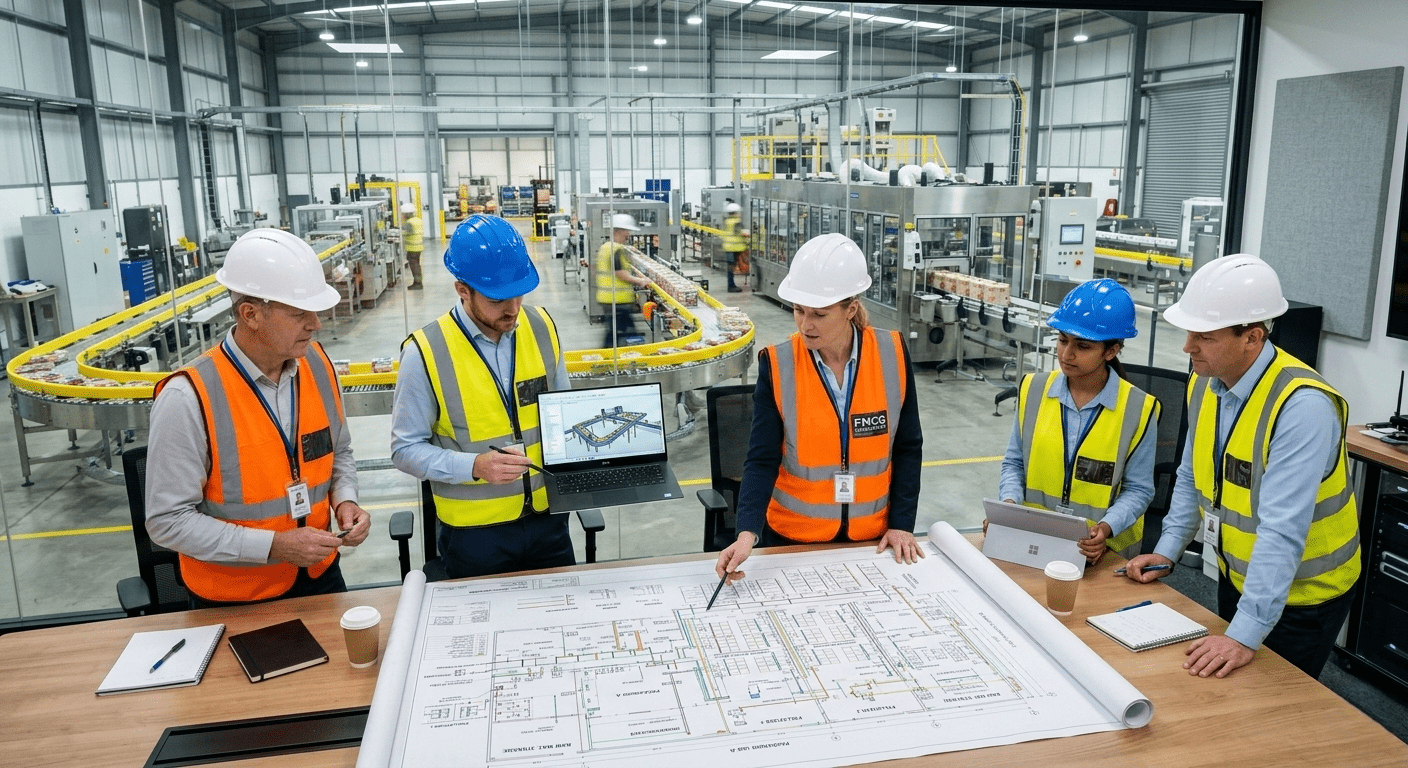
Engineering experts specializing as FMCG Manufacturing Plant Engineering Consultants help optimize production facilities by delivering fully integrated turnkey solutions. Their services typically include engineering design, HVAC systems, cleanroom design, fire protection, electrical & automation controls, civil and structural works, and environmental engineering. By carefully redesigning plant layouts and upgrading systems while operations continue, these consultants enable FMCG manufacturers to achieve 10–30% improvements in efficiency, workflow, and space utilization—without interrupting live production.
Running a fast-moving consumer goods (FMCG) facility is a constant race against time. Every square metre of floor space, every utility connection, and every production line affects how quickly and profitably your plant operates.
Specialist food plant engineering consultants analyse your existing setup, identify inefficiencies, and redesign your factory so that people, materials, and machinery move with far less friction. This article explains exactly how that process works — covering every discipline JDEC brings to an FMCG project — backed by 2026 industry data and practical guidance for manufacturers across India and globally.
JDEC’s Integrated Engineering Services for FMCG Plants
Optimising an FMCG plant is never a single-discipline task. Layout, structure, utilities, controls, safety, and environment must all work together. JDEC delivers all ten engineering disciplines under one roof, eliminating coordination gaps between consultants and reducing project risk.
| Turnkey Project Services End-to-end project delivery — from feasibility through to commissioning — with a single point of accountability. | Engineering Design Services Multi-discipline front-end and detailed design, integrating all engineering systems into a coherent plant solution. |
| Architectural Design Services Functional, GMP-compliant architectural design that supports operational flow, hygiene, and future scalability. | Civil & Structural Engineering Foundation design, structural frames, flooring, drainage, and building envelopes for industrial FMCG environments. |
| Electrical, Instrumentation & Controls / ELV Systems Power distribution, PLC/SCADA, process instrumentation, building automation, access control, and ELV networks. | HVAC & Building Management Systems Precision HVAC design for FMCG plant environments, integrated with BMS for energy monitoring and regulatory compliance. |
| Mechanical Engineering Process pipework, equipment selection, utility systems, compressed air, and mechanical plant layout. | Fire Protection Systems Sprinkler systems, fire detection, suppression, and emergency egress design to NFPA, IS, and international standards. |
| Cleanroom Design Services ISO-classified cleanroom design for food, pharmaceutical, and personal care FMCG applications. | Environmental Engineering Design ETP, STP, waste management, emissions control, and sustainability integration for FMCG facilities. |
| Why Integrated Services Matter When layout, HVAC, structural, electrical, and fire systems are designed by separate consultants, coordination gaps create rework, delays, and compliance failures. JDEC’s single-team model eliminates these gaps — all ten disciplines are co-designed, cross-checked, and delivered under one project management framework. |
Why FMCG Plant Layout Directly Impacts Profitability
In FMCG production, margins are thin and volumes are high. A poorly planned layout forces workers to travel longer distances, creates bottlenecks at critical stations, and increases the risk of cross-contamination in food and beverage lines.
According to the Lean Enterprise Institute, non-value-added movement accounts for up to 35% of total operator time in a traditional factory layout. For a plant running three shifts, that lost time translates directly into higher unit costs and missed delivery targets.
| 35% of operator time lost to non-value-added movement (Lean Enterprise Institute) | 25–40% movement reduction from optimised layouts (McKinsey, 2025) | ₹12–18 Cr average annual saving per mid-sized FMCG plant post-optimisation (JDEC project data) | 12–24 months typical payback period for a full plant layout redesign |
The Three Most Common FMCG Layout Problems
▸ Inefficient material flow — raw materials and finished goods travel long distances and cross paths, creating congestion and contamination risk
▸ Under-utilised vertical space — failure to use mezzanine levels or elevated conveyors, leaving valuable floor area blocked by storage
▸ Poor wet/dry zone segregation — hygiene compliance failures built into the layout from day one, requiring costly retrofits to HVAC, drainage, and finishes
How JDEC Optimises FMCG Plant Layouts: A Step-by-Step Process
Step 1: Current-State Facility Audit — Engineering Design Services
The process begins with a systematic baseline audit. JDEC engineers measure material travel distances, map production workflows, record machine cycle times, and identify bottlenecks and hygiene risk zones.
Civil, structural, mechanical, electrical, and HVAC conditions are all assessed simultaneously — not sequentially. This multi-discipline snapshot ensures nothing is missed before design work begins.
Step 2: Architectural and Civil/Structural Design
Once the baseline is established, JDEC’s architectural and civil & structural engineering teams develop a revised spatial concept. Architectural design focuses on GMP-compliant zoning, traffic flow separation, personnel routing, and future expansion allowances.
Civil and structural engineers simultaneously assess whether existing slabs, columns, and mezzanines can support the revised layout — or whether new structural elements are required. These two disciplines work in the same model, eliminating costly clashes discovered late in the project.
Step 3: Process Flow Simulation and Mechanical Engineering
JDEC’s mechanical engineering team models how products, utilities, and services move through the revised layout. Process pipework, compressed air networks, steam and chilled water distribution, and equipment positioning are all optimised for the new configuration.
Digital simulation tools allow different scenarios to be tested virtually before a single pipe is moved. This step is where packaging plant design integration — balancing filler speeds, labelling rates, and case-packing throughput — takes place.
Step 4: HVAC, BMS, and Cleanroom Design
Layout changes always affect air handling. JDEC’s HVAC for FMCG plant team designs air handling units, exhaust systems, pressurisation zones, and temperature-controlled areas in parallel with the layout — never as an afterthought.
For facilities requiring controlled environments — such as dairy, confectionery, pharmaceutical FMCG, or personal care — JDEC’s cleanroom design services provide ISO-classified rooms with validated air change rates, particle counts, and differential pressures.
A Building Management System (BMS) is integrated to monitor energy use, HVAC performance, and compliance parameters in real time, supporting FSSAI, FSSC 22000, and BRCGS audit requirements.
| HVAC Compliance Note Correct HVAC design for FMCG plants in India must satisfy FSSAI GMP guidelines, BIS standards, and — for export-oriented manufacturers — FSSC 22000 and BRCGS facility requirements. Inadequate HVAC is among the top three causes of food safety audit failures. |
Step 5: Electrical, Instrumentation, Controls, ELV, and Fire Protection
Every layout change triggers electrical and instrumentation redesign. JDEC’s electrical, instrumentation & controls team revises single-line diagrams, panel locations, motor control centres, and process instrumentation to match the new layout.
ELV (Extra Low Voltage) systems — including CCTV, access control, fire alarm, PA systems, and data networks — are designed as part of the same scope, not bolted on later.
Fire protection systems are designed in compliance with NFPA 13, IS 15105, and applicable Indian factory act requirements. Sprinkler layouts, detection zones, and suppression systems are co-ordinated with the ceiling and structural design to avoid clashes.
Step 6: Environmental Engineering, Turnkey Delivery, and Commissioning
FMCG plants generate effluent, solid waste, and atmospheric emissions that require engineered solutions. JDEC’s environmental engineering design team integrates Effluent Treatment Plants (ETP), Sewage Treatment Plants (STP), waste segregation systems, and emissions controls into the project from the start.
As a turnkey project services provider, JDEC manages procurement, construction supervision, vendor co-ordination, and commissioning under a single contract. This eliminates the risk of scope gaps between design and delivery — and gives plant owners a single accountable partner from feasibility to handover.
Measurable Efficiency Gains: What FMCG Plant Owners Achieve
The table below summarises typical improvements observed in JDEC-led FMCG plant projects, corroborated by industry benchmarks from Lean Enterprise Institute and McKinsey.
| Improvement Area | Typical Gain | JDEC Service Applied |
| Material handling distance | 10–25% reduction | Engineering Design + Architectural + Mechanical Engineering |
| Line changeover time | 15–30% reduction | Packaging Plant Design + Layout Optimisation |
| HVAC energy consumption | 8–18% reduction | HVAC & BMS — right-sized to actual production footprint |
| Regulatory audit compliance | Significant uplift | Cleanroom Design + HVAC + Environmental Engineering |
| Fire safety compliance | Full code compliance | Fire Protection Systems to NFPA/IS standards |
| Electrical system reliability | Reduced downtime | Electrical, Instrumentation & Controls redesign |
| Environmental compliance | ETP/STP operational | Environmental Engineering Design Services |
| Capacity scalability | Modular expansion | Turnkey Project Services with phased master plan |
FMCG Plant Engineering in India: Why Local Expertise Matters
India’s FMCG sector was valued at USD 167 billion in 2025 and is projected to exceed USD 220 billion by 2030 (Statista, 2026). Indore and Madhya Pradesh have emerged as key manufacturing hubs for food, beverage, personal care, and household product categories.
Local manufacturers face a dual challenge: meeting global food safety and operational standards while managing capital expenditure carefully. An experienced FMCG project management consultancy in Indore understands both dimensions — the Indian regulatory environment and the international benchmarks that export-focused brands must satisfy.
Key Requirements for FMCG Plant Engineering in India
▸ Multi-product lines with frequent SKU changeovers — requiring fast, low-cost changeover layouts
▸ Monsoon-driven humidity fluctuations — demanding carefully specified HVAC for FMCG plant environments across Indian climatic zones
▸ Mixed regulatory compliance — FSSAI and BIS domestically; FSSC 22000, BRCGS, and ISO 22000 for export markets
▸ Brownfield constraints — most optimisation projects work around existing structures and live production lines
▸ Cleanroom requirements — growing demand for ISO-classified environments in dairy, confectionery, nutraceutical, and personal care FMCG
▸ Environmental compliance — increasing CPCB and state PCB scrutiny of effluent treatment and solid waste management
| About JDEC JD Engineers & Consultants (JDEC) was established in 2003 and is headquartered in Indore, Madhya Pradesh. JDEC delivers engineering design, HVAC, cleanroom, fire protection, civil & structural, electrical & controls, mechanical, environmental, architectural, and turnkey project services for FMCG, pharmaceutical, and infrastructure clients across India and internationally. |
How to Choose the Right FMCG Plant Engineering Consultant
Not every engineering firm has the multi-discipline experience that FMCG plant layout optimisation requires. Use this checklist when evaluating consultants.
Consultant Selection Checklist
- FMCG-specific project references — food and beverage plants, not just general industrial projects
- Integrated multi-discipline capability — all ten engineering disciplines in-house, not subcontracted piecemeal
- Regulatory expertise — FSSAI, BIS, FSSC 22000, BRCGS, NFPA, IS fire codes, and CPCB environmental standards
- Brownfield experience — proven ability to improve a live plant in phases without halting production
- Turnkey delivery track record — projects completed on time, on budget, from concept to commissioning
- Cleanroom and controlled environment capability — essential for food, dairy, nutraceutical, and personal care FMCG
- Environmental engineering competence — ETP, STP, and waste management designed in from the start
- Transparent project management — milestone-driven plans, clear cost controls, and a single accountable contact
Frequently Asked Questions
Q1: What engineering services does JDEC provide for FMCG plants?
A: JDEC provides turnkey project services, engineering design, architecture, civil, electrical, HVAC, mechanical, fire protection, cleanroom, and environmental engineering under one framework.
Q2: How long does an FMCG plant layout optimisation project take?
A: FMCG plant audits typically take 4–8 weeks, while full redesign projects require 6–14 months depending on scope and implementation phases.
Q3: Why is HVAC important in FMCG plant design in India?
A: HVAC controls temperature and humidity, preventing contamination, condensation, and microbial growth while supporting FSSAI, FSSC 22000, and BRCGS compliance.
Q4: What is a cleanroom and when does an FMCG plant need one?
A: A cleanroom controls airborne particles, humidity, and temperature. Dairy, nutraceutical, personal care, and pharmaceutical FMCG plants often require ISO-classified clean environments.
Q5: What environmental engineering requirements apply to FMCG plants in India?
A: FMCG plants must follow CPCB and state PCB norms, including effluent treatment plants, sewage treatment, waste management, and emission control systems.
Partner with JDEC for Your Next FMCG Engineering Project
Whether you are planning a new food processing facility, upgrading an existing packaging line, improving HVAC compliance, installing fire protection systems, or designing a cleanroom — JDEC’s integrated engineering team delivers across all ten disciplines, under one roof, on one contract.
Engineering consultants play a vital role in optimising FMCG plant layouts for efficiency, compliance, and scalability. Through integrated engineering, advanced simulations, and turnkey execution, firms like JDEC help manufacturers streamline workflows and reduce costs. Contact us to discuss how our experts can transform your facility and maximise productivity without disrupting ongoing operations.